
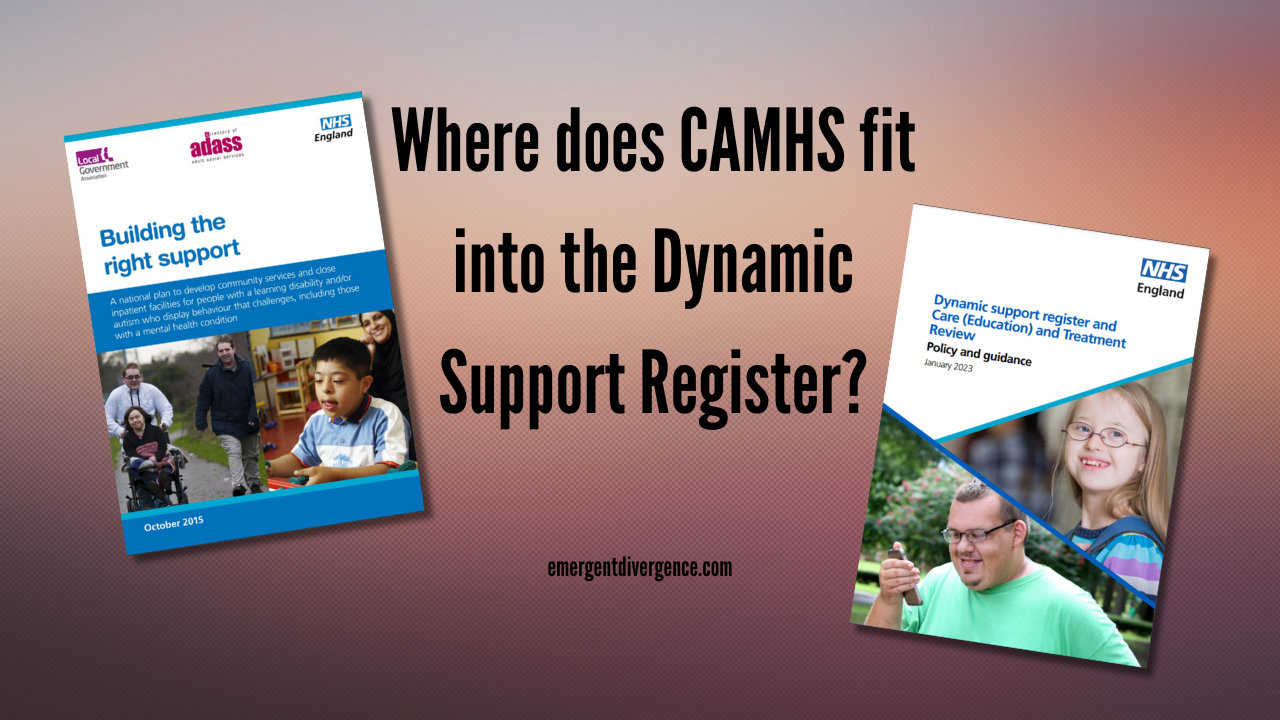
Child and Adolescent Mental Health Services (CAMHS) are responsible for supporting all children and young people with their mental health. Despite this many Autistic people are turned away from their services for no reason other than their diagnosis. It is unsurprising that inpatient treatment is such a frequent discussion when CAMHS are failing them. It intrigues me, then, to see use of something called the “Dynamic Support Register” rising in frequency. The question that stands out to me is this: Does it deliver on it’s promises, and what can we hope to see as a result of its existence?
What is the Dynamic Support Register and why is it relevant to CAMHS?
“Dynamic support registers (DSRs) and Care (Education) and Treatment Reviews
NHS Policy Document
(C(E)TRs) are essential elements of the pathway providing people with a
learning disability and autistic people with appropriate support and care at
the right time – so that they can lead the lives they want to and meet their
ambitions and aspirations; and can stay safely and healthily in the community
or return to this as soon as possible.”
The aim of the DSR is to reduce the number of Autistic and Learning Disabled people being admitted to inpatient psychiatric units. While this is aimed at various age groups, I find it particularly relevant to Autistic children and young people. The DSR arises from the “Building The Right Support” document (2015) that found there needed to be a redesign of pathways for Autistic and Learning Disabled people at risk of hospitalisation or already in hospital.

Image from Building The Right Support (2015)
According to the National Autistic Society. Of the 200 under-18’s in inpatient care, 95% are Autistic. It is clear that their is a distinct risk for Autistic children and young people of encountering the inpatient system. It seems reasonable to infer that this may be related to CAMHS failure to support them adequately.
What does the Dynamic Support Register promise?
“DSRs are the mechanism for local systems to:
NHS Policy Document
- use risk stratification to identify people at risk of admission to a mental health hospital
- work together to review the needs of each person registered on the DSR
- mobilise the right support (eg a C(E)TR, referral to a keyworker service for children and
young people, extra support at home) to help prevent the person being admitted to a
mental health hospital.”
In the context of CAMHS it is relevant to highlight the referral to a keyworker for Autistic children and young people. This is something that has historically proven to be a sticking point for most services. Another key issue is the inconsistency across the workforce with a minority of staff having the knowledge and skills to be effective, but many more lacking the cultural competence to work with Autistic people.
The Building The Right Support document makes the following promises among others;
- “People should be supported to have a good and meaningful everyday life”
- “Care and support should be person-centred, planned, proactive and coordinated”
- “People with a learning disability and/or autism should be able to access specialist health and social care support in the community”
What stands out to me is the failure to meet these aims. Ask any parent about their Autistic child’s experience of services, and they are very unlikely to agree these points have been achieved.
Does CAMHS have to support children on the Dynamic Support Register?
Based on my reading of policy documents and my understanding of them. There is no explicit requirement for CAMHS to be the service providing support to Autistic people on the DSR. This intrigues me as those most at risk of hospitalisation will almost invariably need support for their mental health. Despite this, Access to CAMHS seems to have become harder for Autistic children and young people rather than easier.
Anecdotally, I have worked with young people who are on the DSR. Both they and their families have highlighted that professionals involved don’t seem to achieve much. I find this deeply concerning when considering that this is supposed to be keeping children and young people out of hospital. If we are not admitting people to hospital, and not giving them meaningful support in the community, we are essentially leaving them to struggle on their own.
Implementation of the DSR is contingent on competent professionals
As with all services working with Autistic people. If professionals are not well-versed in Autistic experience, the support will be lacking at best, and harmful at worst. The distinct lack of input into training from Autistic community members highlights the gap in clinical knowledge that exists. The only people able to give a good view into Autistic life is Autistic people. Non-Autistic people can understand us academically, but without a point of reference within our world, they will continue to miss the mark.
CAMHS are worryingly absent from DSR policy documents

A text search of the policy document showing zero mentions of CAMHS in the entire document
As you will see from the image above there were no mentions of “CAMHS” in the entire policy document. I also did a similar search for “Child and Adolescent Mental Health Services” that turned up the same result. I find it deeply troubling that a pathway that is meant to keep Autistic and Learning Disabled children and young people out of inpatient units doesn’t appear to be placing any of the responsibility on CAMHS. CAMHS exist for a reason, and if they don’t have a part in supporting all people’s mental health, then one has to question if they are fit for purpose.
The DSR is not so much a cop out as it is a diversion away from services that Autistic children and young people should have access to.

You must be logged in to post a comment.